
Beyond the Battery: Why the Best Energy Harvesting Companies in 2026 are Finally Killing the Maintenance Cycle
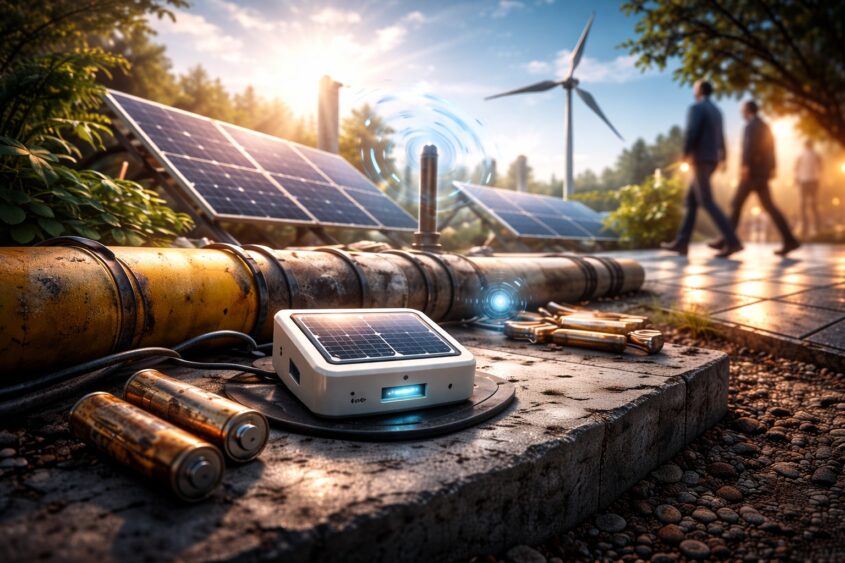
Why 2026’s top energy harvesting companies are ending the maintenance cycle—powering sensors sustainably without batteries or replacement.
For decades, the tech industry has been haunted by a dirty little secret: the “Trillion Sensor” vision was a logistical suicide mission. We dreamed of a world saturated with data, but we ignored the fact that billions of sensors would eventually mean billions of dead batteries scattered across our factories and cities.
But as we move through 2025, the narrative has shifted. We aren’t just talking about “green energy” anymore; we’re talking about survival. The Best energy harvesting companies in 2026 aren’t just selling components—they are selling the freedom from ever having to send a technician with a ladder and a pack of AA batteries into a remote warehouse again.
If you’ve been tracking this space, you know that 2026 is the year the economic argument finally strangled the environmental one. It’s no longer just about being “sustainable”; it’s about the fact that labor costs for battery replacement have skyrocketed to the point of being unsustainable.
The Silicon Giants: More Than Just Suppliers
You can’t start a serious conversation about this without looking at the heavyweights. For a long time, companies like STMicroelectronics and Analog Devices, Inc. (ADI) were seen as the boring “plumbing” of the industry. Not anymore.
In 2026, they’ve moved to the front of the stage. ADI, in particular, has mastered the “Total Power Path.” Their latest PMICs (Power Management Integrated Circuits) don’t just manage power; they hoard it with a level of efficiency that was scientifically impossible five years ago.
What makes these the Best energy harvesting companies in 2026 is their ability to deal with “dirty” energy. Ambient energy isn’t like a wall socket; it’s chaotic, weak, and intermittent. STMicroelectronics has addressed this by baking harvesting logic directly into their STM32 microcontrollers.

They’ve essentially democratized autonomy, allowing a standard hardware designer to build a self-powered device without needing a specialized degree in analog power systems.
EnOcean and the Kinetic Masterclass
Then there’s EnOcean GmbH. If you’ve ever walked into a modern smart building in Berlin or New York and noticed switches that feel a bit “clickier” than usual, you’ve likely met their tech. EnOcean has spent years perfecting the art of turning a finger press into a radio signal. In 2026, they remain the undisputed kings of building automation.
Their brilliance isn’t just in the hardware, but in the ecosystem. By creating a unified standard for batteryless communication, they’ve ensured that their “harvested” data can talk to any building management system on the planet.
They are a prime example of why the Best energy harvesting companies in 2026 aren’t just about the “harvesting” part—they are about what you do with that tiny, precious burst of energy once you have it.

Harvesting the Invisible: RF and Indoor Light
The most radical shift we’ve seen this year involves Radio Frequency (RF) harvesting. For a long time, pulling power out of thin air was treated like cold fusion—a nice idea that never quite worked.
Powercast Corporation has spent the last few years proving everyone wrong. By fine-tuning the link between dedicated RF transmitters and their Powerharvester receivers, they’ve turned entire warehouses into “charging zones.” Your asset tags don’t need batteries if the very air in the room is vibrating with enough energy to keep them alive.
On the other side of the spectrum, literally, we have Ambient Photonics. Traditional solar cells are great for rooftops, but they are useless under the dim LED lights of a modern office. Ambient Photonics saw this gap and ran with it.
Their indoor-optimized silicon cells are now being embedded directly into the chassis of keyboards and remote controls. It’s a simple, elegant solution that makes you wonder why we ever bothered with disposable batteries for office peripherals in the first place.
The Gritty Reality: Industrial and Thermal Power
In the industrial sector, the requirements are brutal. A sensor on a steam pipe in an oil refinery doesn’t care about “elegant design”—it cares about surviving 80°C temperatures and corrosive air. This is the territory of Perpetua Power Technologies. They’ve mastered the Seebeck effect, turning the heat difference between a hot pipe and the ambient air into a steady stream of micro-watts.
In 2026, Perpetua has found its stride in the “predictive maintenance” boom. When you look at the Best energy harvesting companies in 2026 for heavy industry, they stand out because they’ve realized that the machine itself is the battery.
If a pump is vibrating or a motor is hot, that’s energy. Why not use it? This is exactly where e-peas comes in as well. This Belgian powerhouse provides the specialized chips that can “cold-start” a system from almost nothing—vibrations so subtle you wouldn’t even feel them if you put your hand on the machine.
The Edge AI Revolution
We cannot ignore the elephant in the room: Artificial Intelligence. In the past, harvesting energy was only enough to power a “dumb” sensor that sent a raw data point every hour. In 2025, everything has changed. Thanks to the ultra-low-power silicon from leaders like Infineon Technologies, we now have “Self-Powered Intelligence.”
We are seeing sensors that harvest energy from passing cars (vibrational energy), run an AI model locally to detect a specific type of engine failure, and only use their precious radio power to send an alert if something is actually wrong. This marriage of Edge AI and harvesting is the real “killer app” of the decade. It’s the reason why the investment into the Best energy harvesting companies in 2026 has shifted from venture capital speculation to massive corporate R&D budgets.


Scaling Up: The Ocean Frontier
While most of our focus is on tiny sensors, 2026 has seen the principles of energy harvesting scale up to the size of shipping containers. CorPower Ocean and Oscilla Power are taking the same mechanical conversion logic used in a kinetic switch and applying it to the North Sea waves. These aren’t just “wave energy” companies; they are harvesting companies at an infrastructure scale. Their ability to turn the chaotic, destructive motion of the ocean into a predictable electrical output is a masterclass in mechanical engineering.
The Sustainability Mandate
Finally, we have to talk about the “B-word”: Batteries. The global crackdown on e-waste has become a major headache for manufacturers. Between the mining of lithium and the toxic reality of battery disposal, the “old way” of doing things is becoming a legal liability.
By integrating technology from the Best energy harvesting companies in 2026, manufacturers are essentially “future-proofing” their products. If your device doesn’t have a battery, you don’t have to worry about battery disposal regulations. It’s a win-win that has moved the conversation from the engineering department to the boardroom.
Closing Thoughts
The era of the “disposable” digital world is dying, and honestly, it’s about time. The companies we’ve discussed today aren’t just selling a different way to power a gadget; they are redefining our relationship with energy. They are teaching us that energy is everywhere—in the light of a desk lamp, the vibration of a motor, or the heat of a pipe.
As we look toward the end of 2026 and into 2027, the gap between those who embrace autonomy and those who stay tethered to the battery will only widen. For any company building for the next decade, the choice is clear: either you learn to harvest the world around you, or you get left behind in the pile of yesterday’s e-waste.