Dog Harness vs Collar: Which Is Better for Your Dog?
Collar or harness? Learn how fit, behavior, health and walking habits shape the safest, most comfortable choice for your individual dog on every walk.
Inside the house, almost any walking setup looks convincing. The collar fits, the new harness is adjusted and the dog is waiting at the door. Easy.
Then a pigeon takes off two metres away.
That sudden leap tells you far more than the packaging did. With a collar, the jolt is felt around the neck. With a harness, it lands across the chest and body—assuming the harness stays where it should. Sometimes it doesn’t. It twists, creeps into an armpit or becomes loose enough for a determined dog to step backwards and vanish from it.
This is why the dog harness vs collar discussion never has a neat winner. The useful question isn’t “Which product is best?” It’s “What happens when this particular dog wears it?”
Start With the Dog, Not the Debate
Think about the walk you actually have, including its messy parts. Does your dog wander beside you on a loose leash? Pull from the front door to the park? Freeze when a bus passes? Try to chase cats? Their behaviour changes what the equipment has to cope with.
Body shape matters just as much. A whippet’s narrow head can slide through equipment that would hold a Labrador securely. A broad chest, short coat or thick ruff can make a supposedly universal harness fit very differently. Puppies change size constantly; older dogs may become stiffer or more sensitive.

Health belongs in the decision too. If your dog coughs when the leash tightens, has neck pain, breathing difficulties or reduced mobility, don’t guess your way through a rack of products. Ask a veterinarian what should—and should not—carry pressure.
For everyone else, the comparison begins with a fairly ordinary observation: where does the force go when the leash stops being loose?
A Collar Is Simple. That’s Its Real Advantage
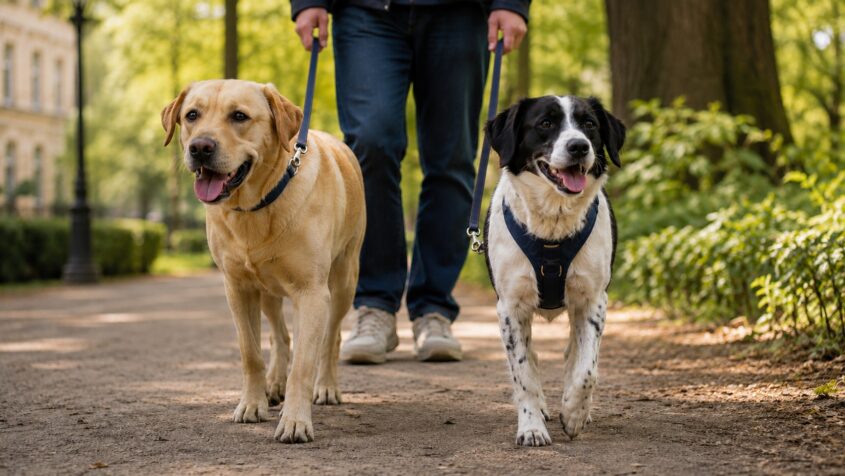
A flat collar is light, quick to fasten and an obvious place for an identification tag. For a dog who walks calmly, that may be enough. There’s little material around the body, nothing sitting behind the elbows and no collection of straps to untangle while the dog circles your legs.
Visible identification is still useful even when a dog is microchipped. The chip has to be scanned. A tag gives the person who finds your dog a chance to call immediately.
There’s also the dog’s opinion. Some dislike putting their head through a harness but show no concern when a collar clips gently around the neck. We tend to treat that reaction as fussiness. It may simply be discomfort, uncertainty or a bad memory of being rushed.
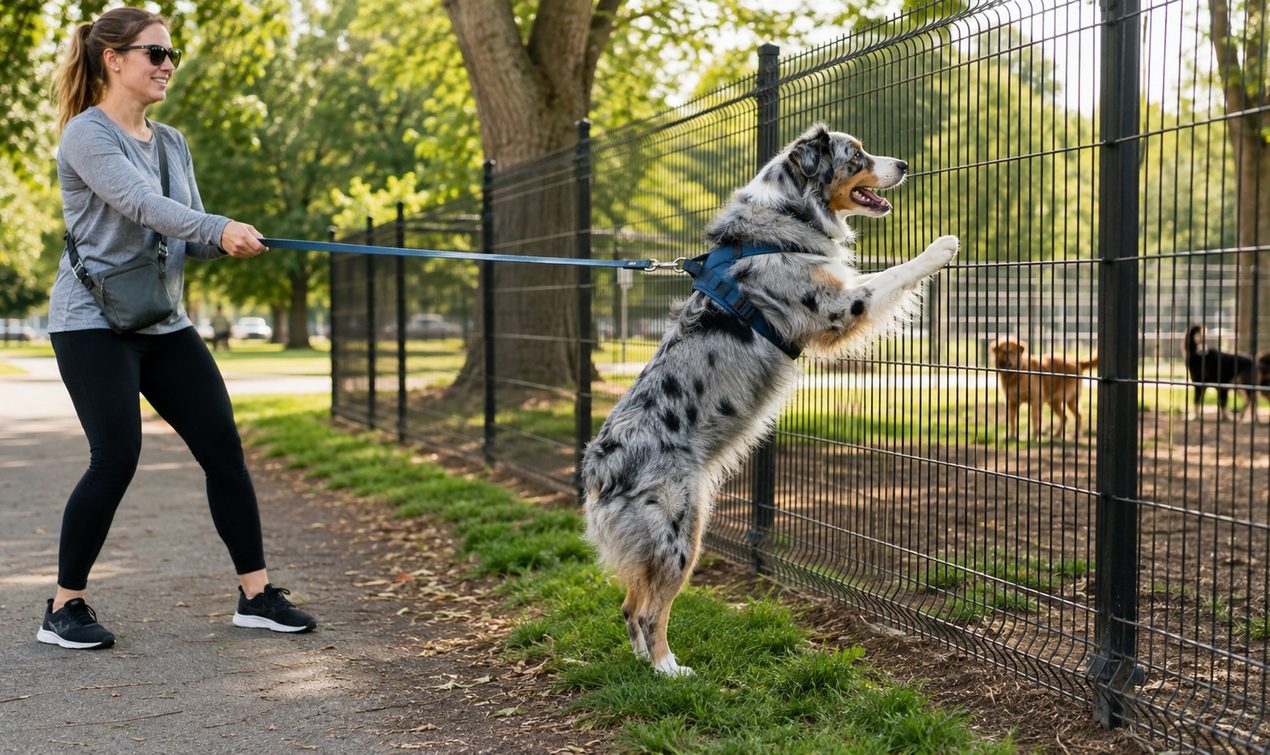
A collar becomes less convincing when the leash spends most of the walk under tension. If the dog lunges, pulls hard or hits the end of the lead at speed, the force is concentrated around a small area. At that point, the simplicity of a collar no longer feels like its most important feature.
Why a Harness Often Makes More Sense
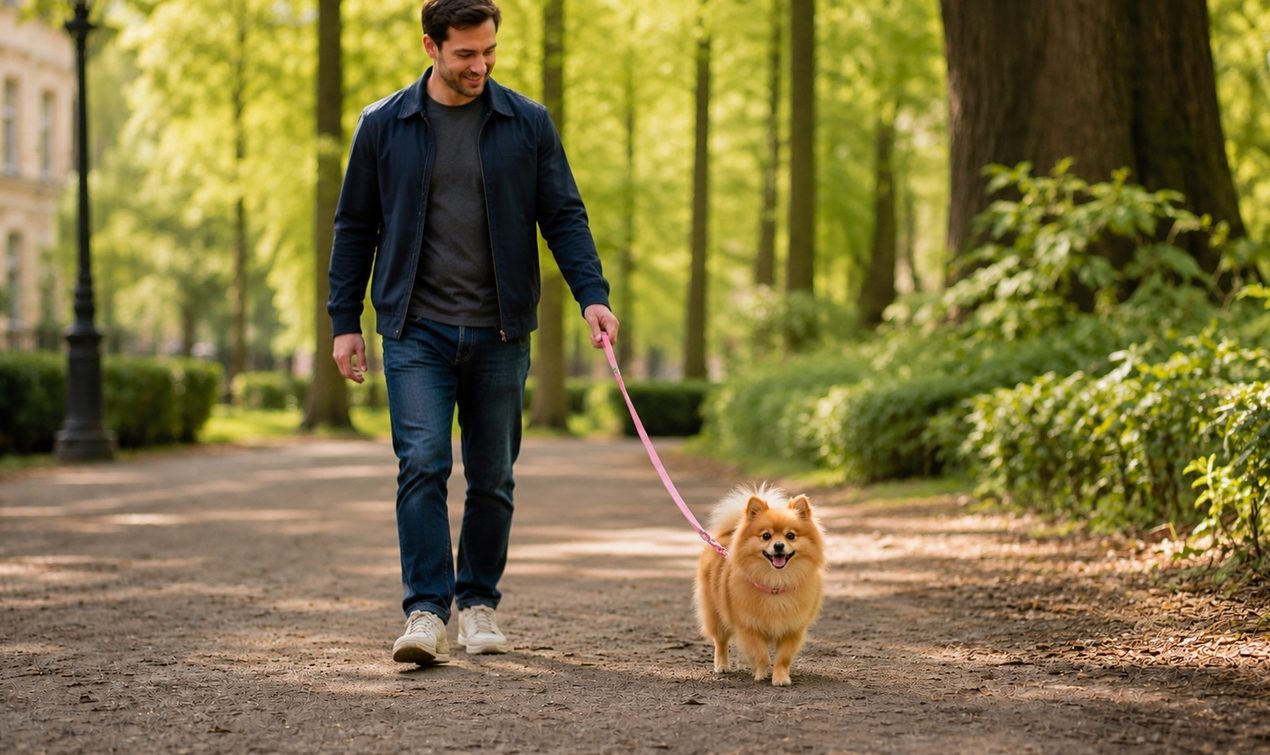
A harness moves the leash connection away from the neck and spreads pressure across more of the body. That can be reassuring with an unpredictable puppy, a dog who startles or one who occasionally launches towards an excellent smell without warning.
It may also offer more security, although not every model does. Nervous dogs can be startlingly good at escaping. They drop their head, brace their front legs and reverse. Suddenly the lead is attached to an empty harness. For dogs with this talent, a correctly fitted three-strap design that sits behind the rib cage is worth considering. A safety connector between harness and collar can add backup, especially during the first weeks after adoption.
Some senior dogs use harnesses with handles or additional support. Those are not ordinary walking accessories with an extra strap sewn on. If a dog needs help with balance, stairs or weakened limbs, the design and lifting points should be chosen with a vet or rehabilitation professional.
And one important correction: “harness” does not automatically mean “comfortable”. A poor design can limit the front legs, press into the throat or rub the skin raw. Moving the problem from the neck to the shoulders is not an upgrade.
Ignore the Size Name and Watch the Walk
Small, medium and large are suggestions, not measurements. Two dogs can weigh exactly the same and have completely different chests. Measure according to the manufacturer’s instructions, then check the result on the living, moving animal in front of you.
For a collar, you should be able to slide your fingers underneath without leaving enough room for it to pass over the head. The familiar two-finger rule is a reasonable starting point, but fur can be deceptive. A fluffy neck may hide looseness; a haircut may reveal it.
A harness takes a little longer to judge. Look at the dog from the front and the side. The chest piece should remain centred. Front legs need to reach forward normally. Straps should sit over the rib cage, not the soft abdomen, and should not crowd the armpits.
Now walk.
Watch again when the dog turns, sniffs and puts some weight into the leash. Does the harness rotate? Does a strap slide towards the throat? Can you see the stride becoming shorter? Five minutes in the garden can expose a bad fit that looked flawless in the hallway mirror.
Check beneath the fur after the first few proper outings. Redness, broken hair and tender patches are obvious warnings. Less obvious is the dog who begins scratching whenever the harness goes on, walks stiffly or quietly disappears when they see you pick it up.
The shape can help. Y-shaped fronts often leave the shoulders freer than a strap running horizontally across them, but the letter on its own proves nothing. Some Y-shaped harnesses still sit badly. Again: watch the dog.
Front Clip, Back Clip and the Pulling Question
A leash attached at the back is straightforward for many dogs. With a strong puller, however, it can feel as though the dog has discovered four-wheel drive. The position makes it easier to lean forward and use the body.
That doesn’t mean the harness taught the pulling.
Dogs pull because something ahead matters more than the person behind them: another dog, a patch of grass, fear, excitement, home. A front attachment may make steering easier by changing the angle, but it isn’t useful if the harness twists across the chest. Some owners prefer two attachment points and a double-ended leash because the guidance feels more balanced.
Whichever option you use, equipment cannot teach a loose leash. Practise somewhere calm, reward the moments of slack and lower the difficulty before trying again on a crowded street. If every walk feels like a physical argument, a qualified reward-based professional can help you find the reason, not just a stronger clip.
You’re Allowed to Use Both
The dog harness vs collar debate sounds as though choosing one means rejecting the other. In everyday life, many dogs wear a flat collar for their tag and a harness for the leash. It’s a practical division of labour.
Neither has to remain on around the clock. Walking equipment can catch on crates, furniture or another dog during play. Once the home is secure, many owners take it off.
Car travel is separate again. A walking harness is not automatically a safe vehicle restraint because a seat belt happens to fit through it. Look for equipment designed and independently tested for travel, then use it exactly as instructed.

Which Is Better for Your Dog?
If your dog rarely tightens the leash, a well-fitted flat collar may work perfectly well for simple walks. If your dog pulls, lunges, startles or needs added security, a good harness is often the more sensible place to attach the lead.
But “good” is doing a lot of work in that sentence.
The right equipment stays in position, allows an ordinary stride and does not leave sore skin. Your dog cannot slip out of it, and you don’t have to wrestle them into it. If those things aren’t true, try another shape or ask a qualified professional to check the fit.
Once the walk begins, the best setup is usually the one neither of you has to think about.
Frequently Asked Questions
Should a puppy wear a harness or collar?
A light harness is often useful for leash walks because puppies move unpredictably while they learn. A flat collar can carry identification. Check both frequently—a puppy can outgrow yesterday’s perfect fit with ridiculous speed.
Can a dog wear a harness all day?
It is generally better to remove a walking harness when it isn’t needed, particularly during sleep, crate time or unsupervised play. Long wear may cause rubbing, hold dampness in the coat or create a snagging risk.
Does a harness stop pulling?
No. It can change how the pulling feels and where the pressure lands, but loose-leash walking still has to be taught. The reason behind the pulling matters more than the accessory.
Can a collar and harness be worn together?
Yes. The collar can hold identification while the leash attaches to the harness. Suitable backup equipment may be useful for a dog with a history of escaping.