
What Human Foods Can Cats Eat?
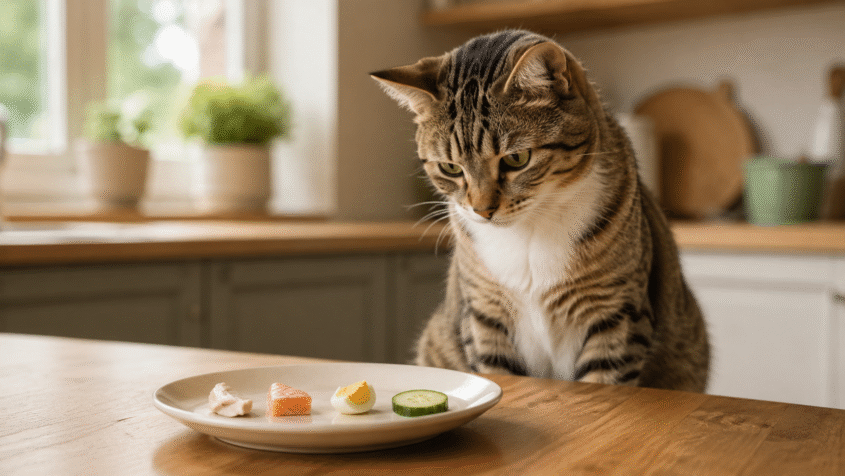
There’s chicken on your plate. Your cat has noticed.
Five minutes ago, she was asleep in another room. Now she’s sitting beside your chair, looking as though nobody has fed her since 2019. You cut off a tiny piece and then pause. The chicken itself should be all right, surely. But what about the gravy? And the garlic? Does the crispy skin make a difference?
It does, actually.
When people ask me what human foods cats can eat, they’re often hoping for a straightforward list. Chicken: yes. Chocolate: no. Tuna: maybe. Job done.
Kitchen food doesn’t quite work that way. A plain piece of chicken and a piece taken from a heavily seasoned roast may look almost identical, but they’re not the same treat. One is simply cooked meat. The other may have picked up salt, butter, onion, garlic and whatever went into the stock.
The details matter more than the name of the food.

If in doubt, start with chicken
Plain, properly cooked chicken is probably the least complicated thing to share. Turkey works too, as does a little lean beef.
I mean a little. Cats are small, despite the confidence with which they attempt to negotiate half a roast dinner. A piece the size of your fingernail is plenty for a treat.
Take off the skin, cut away the fattier parts and check for bones. Then check again. Cooked bones can splinter, so this isn’t one of those occasions when “she’ll probably chew around it” is worth testing.
The easiest trick happens before dinner reaches the table. While cooking, put one small piece of meat to the side before you add anything else. No salt, no marinade, no oil. Cook it through and leave it to cool. That’s the cat’s share sorted.
It also avoids the strange kitchen conversation that usually goes like this:
“It’s only chicken.”
“Was it seasoned?”
“Only a bit.”
“With what?”
“Well… garlic, mostly.”
At that point, we’re no longer talking about plain chicken.
Lamb and pork aren’t automatically off the menu, although rich, fatty pieces can be rough on a cat’s stomach. Processed meat is another matter. Ham, bacon, salami and sausages smell glorious to most cats, which is unfortunate because they’re usually salty, fatty and seasoned. Sausages are particularly sneaky. Onion and garlic powder often turn up in the ingredients, even when you can’t taste them.
No need to lose your mind if the cat grabs a crumb of ham that falls from a sandwich. Just don’t make a habit of putting ham in the bowl.
The tuna cupboard
Few sounds travel through a house faster than the click of a tuna tin opening.
Cats who haven’t responded to their names all morning will suddenly appear in the kitchen with excellent hearing and urgent business. Tuna has that effect.
A spoonful of tuna can be offered occasionally. Choose one packed in water if possible. Tuna in brine comes with extra salt, while the oil-packed kind can be a bit much for cats with sensitive digestion.
The problem isn’t usually the occasional spoonful. It starts when tuna becomes the solution to every meal.
Cats learn quickly. If refusing dinner leads to better-smelling tuna, some of them will happily continue the experiment. Before long, the owner is serving half a tin every night because “she won’t eat anything else”.
Tuna sold for humans isn’t made to cover a cat’s full nutritional needs. It’s a treat, or sometimes a useful way to encourage a cat who has gone off their food. It shouldn’t quietly replace a balanced cat food.
Other cooked fish can be shared as well. Salmon and cod are easy examples. Remove every bone you can find and forget the buttery sauce, batter or smoky seasoning. Smoked salmon may look like an elegant little treat, but it contains far more salt than a cat needs.
Fish bones deserve patience. The very thin ones are good at disappearing between the flakes, precisely where you thought you had already checked.
An egg? Possibly
Some cats love egg. Others sniff it once and walk away as though you’ve embarrassed yourself.
Either response is fine.
A piece of hard-boiled egg is the simplest option. Fully cooked scrambled egg is also suitable if it hasn’t been prepared with butter, milk, cheese, salt or seasoning. In other words, take the cat’s portion out before turning breakfast into something you would personally enjoy.
Raw egg isn’t worth it. Nor is a random scrap of raw chicken or fish from the worktop.
Raw feeding has its own rules and needs proper planning. It isn’t the same as letting a cat lick uncooked meat juices from a chopping board. For an occasional treat, cooking the food removes an unnecessary gamble with bacteria.
The vegetable question gets odd
Cats don’t need their dinner to look colourful.
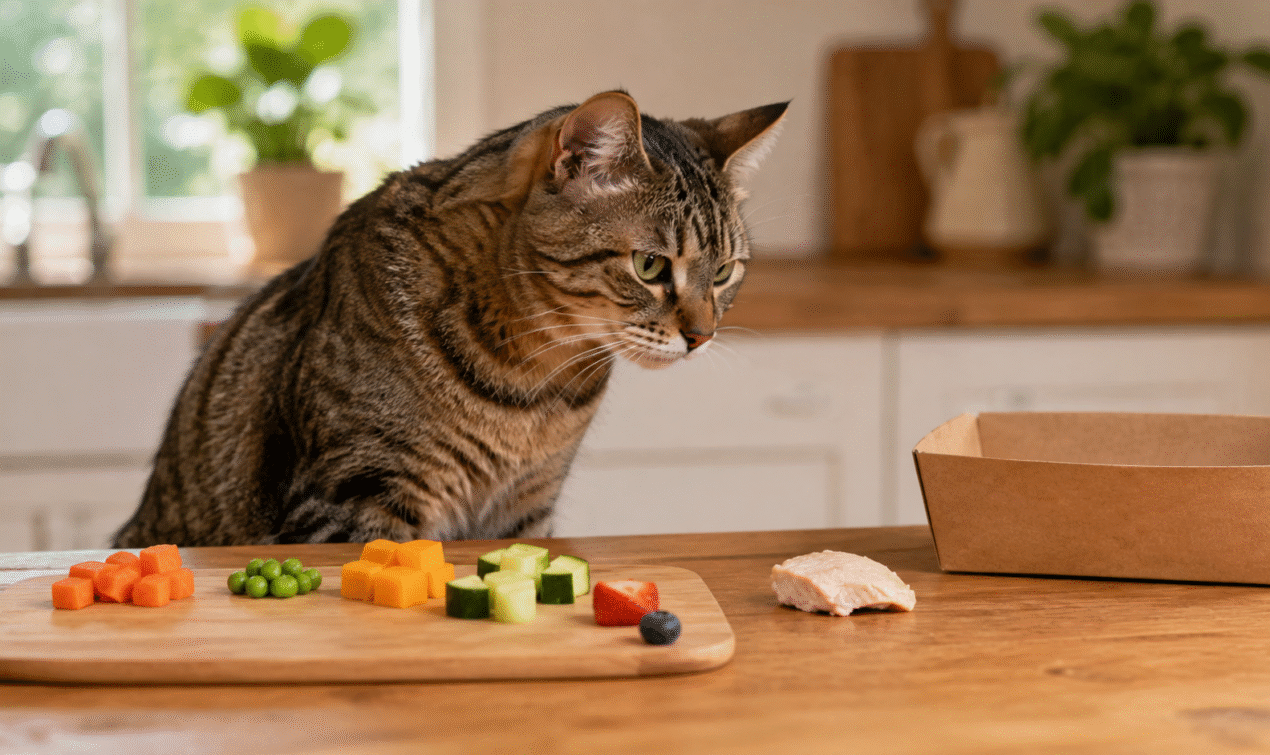
They’re obligate carnivores, so their bodies rely on nutrients that come from animal tissue. A neat arrangement of carrot, peas and pumpkin may photograph beautifully, but your cat isn’t scrolling through wellness accounts. She probably wants the chicken. Or the cardboard box the vegetables arrived in.
Still, cats have peculiar individual tastes. One may steal peas. Another may crunch cucumber. I’ve seen cats show more interest in courgette than in expensive treats purchased specifically for them.
A small amount of plain pumpkin, cooked carrot, peas, courgette or cucumber is usually reasonable if the cat genuinely likes it. There’s no need to persuade them. Vegetables are an optional nibble here, not a dietary achievement.
Pumpkin, in particular, has become the internet’s answer to almost every litter-tray problem. It can sometimes be useful, depending on what’s going on. It can’t diagnose the cat.
If a cat keeps vomiting, has diarrhoea that won’t settle, strains in the litter tray or cannot pass stool, put down the pumpkin spoon and call the vet. Digestive problems have more than one possible cause.
Most cats couldn’t care less about fruit
You can offer a tiny piece of strawberry, banana, peeled apple or seedless melon. The cat may lick it. More likely, they’ll look at you with mild suspicion and wait for something that used to have feathers.
Cats don’t experience sweetness in the way we do. Fruit doesn’t hold the same appeal for them, and they aren’t being deprived if they refuse it.
Every so often, a cat becomes obsessed with watermelon or enjoys batting a blueberry under the fridge. Fair enough. Keep the amount small, remove peel, stones, pips and stalks, and see it as a curiosity rather than a useful part of the diet.
Grapes and raisins don’t belong in the cat’s food. Keep them out of reach, including the ones baked into cakes, bread or biscuits.
About that saucer of milk
The cat-with-a-saucer image has done a lot of work over the years. It appears in children’s books, old cartoons and probably half the kitchens drawn in the last century.
Real adult cats often struggle with lactose.
Milk may lead to wind, stomach discomfort and diarrhoea, even if the cat drinks it eagerly. Enjoying something and digesting it well are two completely separate matters. Cats also enjoy chewing plastic packaging, so I wouldn’t let enthusiasm settle the argument.
Cheese and cream aren’t much better. They bring fat, salt and calories, none of which makes them especially useful as treats. A tiny stolen piece of cheese probably won’t cause a healthy cat any trouble. Still, if plain chicken is available, the chicken wins.
Cat milk has less lactose than ordinary cow’s milk. It’s fine as an occasional extra, but it isn’t a replacement for water and doesn’t need to become a daily ritual.
Read the back of the packet
The obvious dangers are easy to remember. Most people know that chocolate and alcohol shouldn’t be anywhere near a cat.
It’s the ordinary savoury foods that catch people out.
Onion, garlic, shallots, leeks and chives are unsafe for cats. That includes dried flakes and powders. You won’t always see visible pieces in the food, either. Garlic powder can be buried in a spice mix. Onion often turns up in stock cubes, gravy, soup, sauces, ready meals, sausages and marinades.
This is why wiping the sauce off a piece of meat doesn’t necessarily turn it back into plain meat. The ingredients have already been cooked together.
Coffee, tea and energy drinks should stay out of reach as well. The same applies to raw bread dough, cooked bones and foods made with unfamiliar sweeteners. A cat doesn’t need to drink directly from a coffee cup to get into trouble; knocking it over and licking the spill is enough reason to be careful.
If something does disappear from the kitchen, find the packaging. Don’t rely on a vague memory of what was in it. Check the full ingredient list, estimate how much the cat ate and note the time.
Then phone the vet if there is any possibility that the food was toxic. Waiting for the cat to “look ill” wastes useful time. Trying to make a cat vomit at home can make matters worse, so leave that decision to a professional.
What can you actually put in the bowl?
For a healthy cat, the least troublesome choices are wonderfully dull:
a bite of plain cooked chicken, a little turkey or lean beef, some boneless cooked fish, or a small piece of fully cooked egg.
Perhaps a slice of cucumber if your cat happens to be one of those cucumber cats.
That’s enough. There’s no need to recreate your own meal in miniature, and pouring gravy over it won’t make the gesture more loving. Cats are very persuasive around food. They’re also completely unqualified to decide what’s safe for them.
Give them one plain bite. Endure the staring. Finish your dinner.