Zero-Waste Living Tips That Actually Stick
Practical zero-waste living tips to reduce waste, simplify routines, and make sustainable choices for daily eco-friendly life.
Zero-waste living has a reputation problem. For many people, it still sounds like a lifestyle reserved for the hyper-organized: spotless jars, perfectly portioned bulk buys, a week’s worth of trash fitting into a single mason jar. The reality is messier—and, frankly, more interesting.
Most attempts don’t fail because of laziness. They fail because the “tips” are often disconnected from how households actually run: rushed mornings, picky eaters, last-minute errands, social plans, and the quiet fatigue that makes convenience feel like oxygen.
That’s why the best Zero-Waste Living Tips tend to look less like rules and more like smart systems—small defaults that reduce waste without requiring constant willpower.
What follows isn’t a purity checklist. It’s a field guide to the practical moves that keep working after the initial burst of motivation fades.
Start where waste is born: friction and convenience
Waste is rarely the result of a single bad decision. It’s the byproduct of friction. When something is annoying, slow, or hard to maintain, the disposable option wins.
A very common pattern: someone goes “all in” with ambitious swaps—cloth everything, DIY everything, buy-nothing everything—then hits the first busy week and snaps back to the fastest option.

The smarter approach is to identify the moments when convenience is currently doing the heavy lifting and replace them with lower-waste convenience.
The two-question audit that changes everything
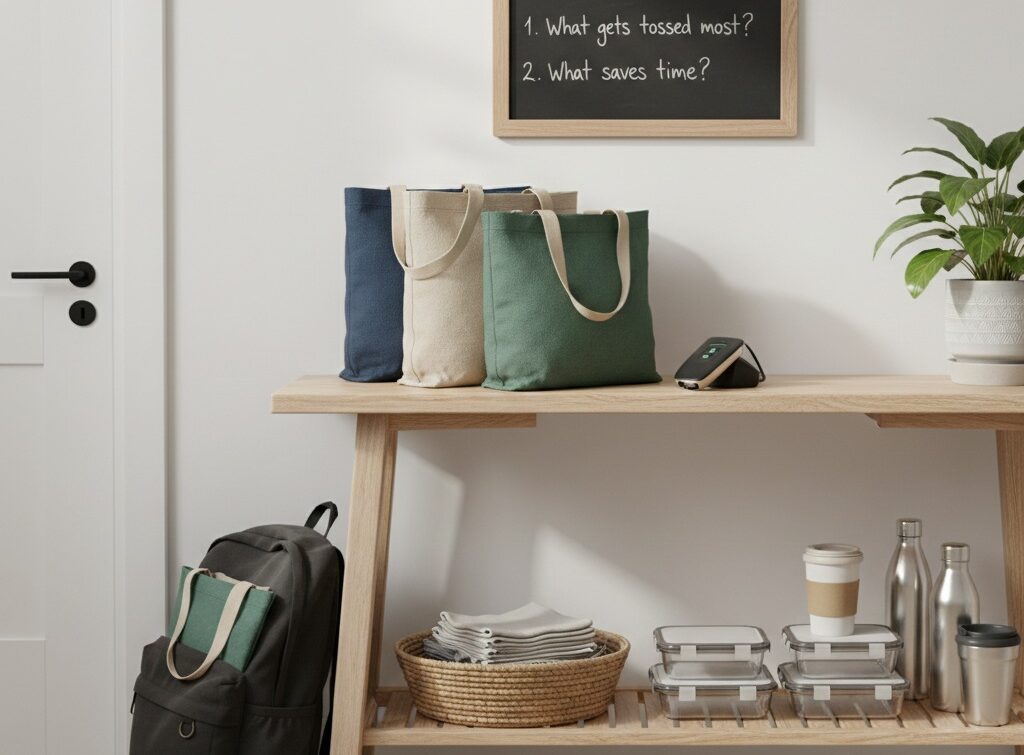
Before buying anything “zero-waste,” it helps to look at two questions:
- What gets thrown away most often?
- What gets bought most often because it saves time?
In many households, the answers are boring and predictable: paper towels, plastic food packaging, takeaway containers, bottled drinks, coffee pods, impulse toiletries. That’s not failure. That’s the map.
Systems beat motivation
Motivation is a spark. Systems are plumbing.
A simple example: it’s easy to remember reusable bags when they live in the car, the entryway, and the daily backpack. It’s much harder when they’re “somewhere in a drawer.” The difference is not moral. It’s logistical.
The kitchen: where “good intentions” go to die (and how to fix it)
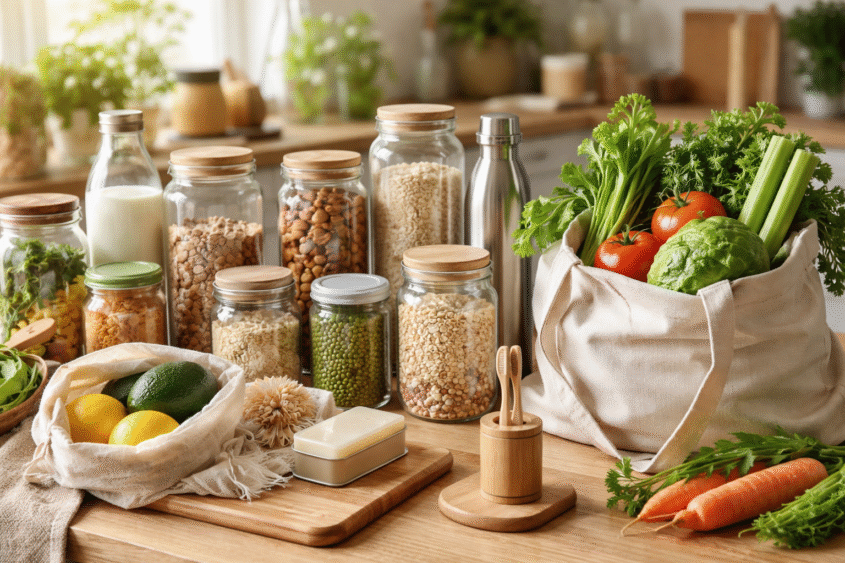
The kitchen is the main battlefield because it’s where habits collide with hunger and time pressure. Most waste here isn’t plastic—it’s food. And food waste has an ugly double impact: wasted money and wasted resources.
Stop treating leftovers like a punishment
It often happens that leftovers are treated as the thing that appears when cooking ‘goes wrong.’ Then they sit in the fridge until they turn into a science project.
A better rule is to cook with leftovers in mind, not as an afterthought:
- Roast vegetables become next-day wraps, grain bowls, or omelets.
- Plain rice becomes fried rice or soup.
- A basic tomato sauce becomes pasta, shakshuka base, or pizza topping.
The shift is psychological: leftovers aren’t repeats—they’re components.
The “visible fridge” principle
A situation that shows up in most kitchens: fresh food disappears into drawers and gets forgotten. The cure isn’t more containers; it’s visibility.
A practical method:
- Put ready-to-eat items at eye level (washed greens, cut fruit, cooked grains).
- Use one dedicated “eat-me-first” shelf or bin.
- Keep condiments and long-life items lower, not front and center.
This isn’t aesthetic. It’s a decision-making hack: people eat what they see.
Bulk buying: useful, but often misunderstood
Bulk stores are treated like a zero-waste rite of passage, but they’re not automatically better. Many first-timers buy huge amounts to “reduce packaging,” then watch half of it go stale.
In most cases, bulk works when it’s tied to realistic consumption:
- staples actually used weekly (oats, rice, lentils)
- refillable detergents that match the household’s pace
- spices in small quantities unless cooking is truly spice-heavy
The best bulk purchases are the boring ones. The flashy ones are often the ones that get wasted.
Shopping habits: less “swapping,” more decision architecture
Many people approach zero-waste as a shopping problem: replace plastic with bamboo, replace disposable with reusable. That helps—but it can also become a consumerist loop with a green label.
The more effective shift is to treat shopping as a behavior design problem.
Reduce “emergency purchases” with tiny preparation
Most waste happens in emergency mode: forgetting lunch, running late, realizing there’s nothing for dinner, needing a last-minute gift, grabbing a drink because thirst hits in public.
A few low-effort defaults reduce that entire category:
- a snack option always in the bag (nuts, fruit, crackers in a reusable container)
- a water bottle that’s genuinely easy to carry (not the heavy “ideal” one)
- a freezer backup meal (something actually appealing, not “health penance”)
Zero-waste isn’t only about what’s bought. It’s about preventing the moments that force the worst options.
Packaging decisions that actually matter
Not all packaging is equal, and pretending otherwise creates confusion. In real life, the “perfect” option is often unavailable or expensive, so choices become trade-offs.
Practical hierarchy that tends to work:
- Avoid single-use when possible (especially items used daily).
- Prefer recyclable, widely accepted materials where local infrastructure exists.
- Be cautious with “compostable” claims—many require industrial composting and don’t break down in a home bin.
- Prioritize reusables for high-frequency items (coffee, lunch, shopping, cleaning).
This is where many Zero-Waste Living Tips become unhelpful because they ignore local systems. A glass jar that travels across the world isn’t automatically a hero. A lightweight refill pouch might be a better choice depending on transport and recycling reality. Purity narratives don’t reduce waste. Practical ones do.
Cleaning and household routines: the hidden waste generators
Cleaning is deceptively waste-heavy because it’s tied to product marketing and “freshness” myths.
The truth about “specialized” cleaning products
In most households, there are far too many bottles: one for glass, one for bathroom, one for kitchen, one for floors, one for “deep clean.” Most of them do overlapping jobs.
A recurring pattern: people chase the one product that promises to make cleaning easier, then end up with half-used bottles under the sink.
A simpler approach:
- one all-purpose cleaner (refillable if possible)
- one degreaser (or a stronger concentrate)
- one bathroom-specific option if needed
- a basic scrub and cloth system that’s washable
Fewer products usually means less waste and less cognitive clutter.
Paper towels: a classic “small leak” with big volume
Many try to quit paper towels overnight, then revert because cloths aren’t where they’re needed. What tends to work:
- keep a small stack of washable cloths in multiple locations (kitchen, bathroom, cleaning caddy)
- have a designated “used cloth” basket
- wash them with towels so it doesn’t feel like an extra chore
This is a perfect example of systems over discipline.
Bathroom and personal care: avoid the all-at-once trap
Bathroom swaps are popular because they’re tangible. They’re also where many people overspend on “eco” products that don’t fit their routines.

Common mistake: switching everything at the same time
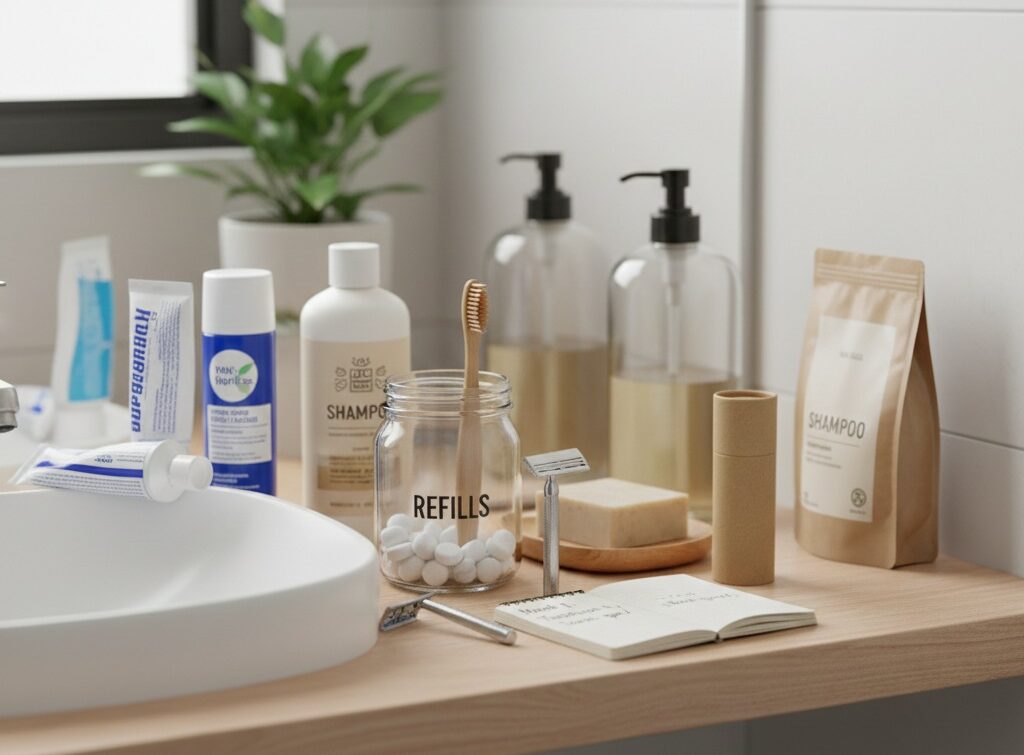
Those who are new to this lifestyle often try to replace shampoo, deodorant, toothbrushes, razors, cotton pads, skincare, and makeup all in one weekend.
Then something doesn’t work—hair feels weird, skin reacts, the razor is inconvenient—and the whole experiment gets blamed.
A calmer strategy is to change one category at a time, based on what gets used fastest:
- start with items that run out monthly (toothpaste, soap, deodorant)
- test one alternative for two to three weeks
- keep a backup option during the transition to avoid panic purchases
Refill culture beats “zero-plastic” aesthetics
Solid bars are trendy, but refills can be more practical for many households. Refill stations or large-format refills (when truly used) often create less packaging per use than constantly buying “pretty” small products.
The goal isn’t a curated shelf. It’s a routine that doesn’t generate a constant stream of empties.
Clothes and textiles: the waste nobody wants to talk about
Waste isn’t only in bins. It’s also in closets.
Fast fashion and overbuying are major drivers, but the daily waste shows up in subtler ways: impulse purchases, “special occasion” outfits worn once, synthetic fabrics that shed microfibers.
The most effective wardrobe habit is boring: fewer, better washes
Many people ruin clothes early with overly frequent washing or harsh cycles. That shortens lifespan and increases fiber shedding. Small changes that make a real difference:
- wash less often when possible (especially denim and outer layers)
- use colder cycles and gentler settings
- air-dry when feasible
- repair small issues early (buttons, seams) instead of waiting for “later” that never comes
Zero-waste here isn’t aesthetic minimalism. It’s keeping what already exists in use.
Secondhand is great—when it’s intentional
Secondhand shopping can become its own form of overconsumption: buying more because it feels virtuous. A frequent scenario is a closet that keeps growing while “waste-free” purchases keep coming in.
A useful rule: secondhand should replace buying new, not replace being selective.
Social life and convenience culture: the awkward part of zero-waste
This is where many Zero-Waste Living Tips become unrealistic. Social settings are full of disposables: takeaway cups, party plates, plastic-wrapped snacks, impulse gifts.
Boundaries work better than speeches
Most people don’t want a lecture at a birthday party. A quiet, consistent approach works better:
- bring a reusable cup or bottle without making it a statement
- offer to bring one dish in a container that can be taken back home
- suggest potlucks where leftovers are part of the plan
- keep a small “go kit” (cutlery, container) in a bag for surprise meals out
It’s not about converting friends. It’s about reducing personal waste without making everything weird.
Gifts: the packaging problem nobody budgets for
A common pattern: someone tries to go waste-free, then gets hit by holidays and occasions and suddenly buys piles of wrapping paper, tape, plastic ribbon, and novelty items.
Alternatives that are actually acceptable socially:
- reusable gift bags or cloth wraps kept in a “gift drawer”
- wrapping with paper that already exists (brown paper, maps, newspaper-style prints)
- experience gifts, consumables, or secondhand finds with good presentation
The key is not to be “anti-gift.” It’s to be anti-trash.

The mindset shift that makes it sustainable
Zero-waste fails when it becomes a personality test. It succeeds when it becomes a quiet set of defaults.
A useful way to judge any habit is to ask: Would this still happen during a stressful week? If not, it’s probably too fragile.
Many people get stuck chasing perfect swaps while ignoring the big wins:
- eating food before it spoils
- buying less, choosing better, keeping items longer
- preventing “emergency convenience” purchases
- building routines that don’t require constant attention
Zero-waste isn’t a finish line. It’s an ongoing negotiation with modern life—one that becomes much easier when the focus shifts from being impressive to being consistent.
Small wins compound faster than dramatic changes
A reusable bottle used daily beats a perfect zero-waste grocery trip done once a month. A simple leftover routine beats a fridge full of aspirational produce. A refill habit beats a cabinet full of “eco” experiments.
The most effective low-waste households aren’t the ones that never slip. They’re the ones that design their lives so slipping doesn’t undo everything.