Best Digital Nomad Jobs in 2026: Income, Skills and Where to Apply
Last updated: October 23, 2026
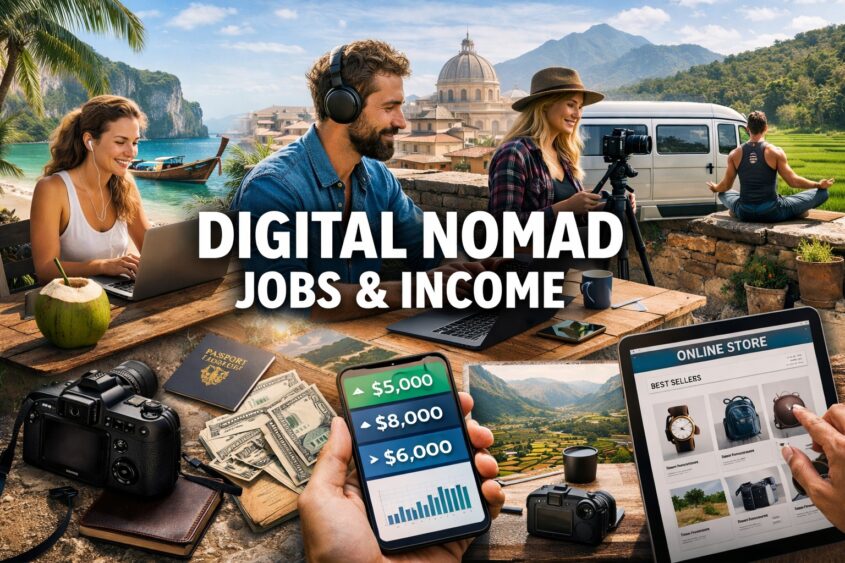
Working while traveling is no longer limited to software developers or full-time content creators. In 2026, digital nomad jobs cover a much wider range of careers, including remote employment, freelance services, consulting, online teaching and running a location-independent business.
However, not every remote role works equally well on the road. Salary, time zones, internet access, contract conditions and employer policies can all affect how practical a job really is. Freelancers may have greater flexibility, for example, but they also need to manage clients and less predictable income.
This guide breaks down the main ways digital nomads earn money, the skills required for different roles, indicative income ranges and the platforms commonly used to find remote opportunities. It also considers living costs and income stability, helping you compare the available options more realistically.
If you’re still figuring out where to begin, our guide to becoming a digital nomad covers the practical steps, from developing remote-friendly skills to choosing your first destination.
1. What Counts as a Digital Nomad Job?
A digital nomad job is any role that can be performed online without requiring a regular presence in a particular office or city. It may involve working as an employee, providing freelance services, consulting for clients or running an online business.

However, “remote” does not always mean “work from anywhere.” Some employers restrict where team members can work for legal, payroll, security or time-zone reasons. Before accepting a position, check which locations are permitted, whether fixed working hours apply and if international travel is compatible with the contract.
The most suitable jobs for digital nomads generally allow work to be delivered online, measure performance through results and offer enough geographical flexibility to move without disrupting clients or colleagues.
How you are paid matters just as much as the work itself. Most digital nomad income falls into four main models, each offering a different balance between stability, flexibility and earning potential.
2. Four Ways Digital Nomads Earn Money
Digital nomads can build their income in several ways. Some work for one company, while others combine clients, personal projects and different revenue streams. Each model offers a different level of stability, flexibility and responsibility.
A. Remote Employment
Remote employees work for a company on a full-time or part-time contract. This is generally the most predictable option because it may include a regular salary, paid leave, career progression and other employee benefits.
Common remote roles include:
- Software developer
- UX/UI designer
- Project manager
- Customer support specialist
- Digital marketing specialist
- Data analyst
A remote contract does not always allow international travel. Some companies limit the countries where employees can work or require them to follow specific time zones, so these conditions should be checked before planning a move.

B. Freelancing and Consulting
Freelancers provide services to several clients and are usually paid by the hour, by project or through a monthly retainer. They have more control over their workload and location, but they are also responsible for finding clients, managing deadlines and handling periods of lower demand.
Common freelance services include:
- Writing and editing
- Graphic and web design
- Social media management
- Video editing
- SEO and digital marketing
- Translation
- Virtual assistance
- Business consulting
Luca Bartoli’s story offers a closer look at what freelancing on the road can involve. After years in advertising, he rebuilt his career as an independent copywriter and began working from different parts of the world.
C. Online Businesses and Digital Products
Some digital nomads earn money by selling products or services through their own online business. This model can grow beyond hourly work, but it usually requires considerable time, testing and investment before becoming profitable.
Common business models include:
- E-commerce
- Print-on-demand
- Digital products
- Online courses
- Memberships
- Affiliate websites
- Software-as-a-service
- Niche websites and newsletters
These businesses are often described as sources of passive income, although most still require regular marketing, customer support and maintenance.
D. Content Creation and Audience-Based Income
Content creators build an audience through platforms such as YouTube, Instagram, TikTok, podcasts or newsletters. Their income may come from several sources:
- Advertising
- Brand partnerships
- Affiliate commissions
- Paid subscriptions
- Digital products
- Memberships
- Events or consulting
Audience-based income can fluctuate significantly, particularly in the early stages. For this reason, many creators combine content with freelance work, consulting or another more predictable source of income.
Some digital nomads rely on one of these models, while others combine two or more. The most suitable option depends on your experience, financial situation and willingness to manage uncertainty.
3. Common Digital Nomad Jobs and Income Benchmarks
There is no standard digital nomad salary. Income varies according to experience, location, contract type, working hours and the market in which clients or employers operate.
To provide a consistent point of reference, the table below uses the latest available median pay for comparable occupations in the United States. These figures are useful as benchmarks, but they should not be interpreted as typical earnings for every digital nomad.
| Role | Common Working Model | U.S. Median Pay, May 2025 |
|---|---|---|
| Software Developer | Remote employment or contracting | $135,980 per year |
| Data Scientist | Remote employment or consulting | $120,230 per year |
| Web and Digital Interface Designer | Employment or freelancing | $104,000 per year |
| Project Management Specialist | Remote employment or consulting | $102,320 per year |
| Web Developer | Employment or freelancing | $92,650 per year |
| Technical Writer | Employment, freelance or contract work | $90,390 per year |
| Market Research Analyst | Remote employment or consulting | $78,760 per year |
| Writer or Author | Employment, freelance or contract work | $76,910 per year |
| Film and Video Editor | Employment or freelancing | $75,420 per year |
| Graphic Designer | Employment or freelancing | $62,960 per year |
| Interpreter or Translator | Employment or freelancing | $60,170 per year |
| Customer Service Representative | Remote employment | $21.53 per hour |

A note about these figures: the data represent median pay for comparable U.S. occupations, not worldwide digital nomad earnings. They generally do not reflect the income of self-employed workers. Freelancers may earn considerably more or less depending on their specialization, client base, workload and ability to find recurring projects.
Pay should also be considered alongside taxes, benefits, unpaid leave, software costs and the time freelancers spend finding and managing clients. A higher gross income does not always result in greater financial stability.
Source: U.S. Bureau of Labor Statistics, Occupational Outlook Handbook. May 2025 wage data, checked in October 2026.
4. What Affects Digital Nomad Income?
Two people doing the same job can earn very different amounts. Experience matters, but digital nomad income is also influenced by specialization, contract type, client location and the ability to secure recurring work.
The main factors include:
Experience and Portfolio
A strong portfolio provides evidence of what you can deliver. This is particularly important for freelancers, designers, writers and developers, whose work is often assessed through previous projects rather than qualifications alone.
Specialization
General skills tend to face more competition. Professionals who solve a specific problem, work in a technical field or understand a particular industry may find it easier to charge higher rates.
Employment or Freelancing
Employees usually receive a predictable salary and may have access to paid leave and other benefits. Freelancers have more control over their prices and workload, but their income can change from one month to the next.
Client and Employer Location
A professional living in Thailand may work for a company in Germany or serve clients in the United States. Where the income comes from can therefore matter more than the place where the digital nomad is currently living.
Recurring Work
Long-term contracts and monthly retainers can make freelance income more predictable. Constantly looking for one-off projects takes time and makes financial planning more difficult.
Working Hours and Availability
Part-time freelancers, full-time employees and business owners have very different earning structures. Time-zone availability can also affect which clients or companies someone is able to work with.
| Career Stage | Typical Situation | Main Priority |
|---|---|---|
| Starting out | Limited portfolio and professional network | Build experience and demonstrate reliable work |
| Established | Stronger skills and recurring clients | Develop a specialization and improve rates |
| Experienced | Recognized expertise or leadership responsibilities | Focus on higher-value projects, consulting or scalable services |
Income growth is rarely linear. A more experienced professional may earn less during a quiet freelance period, while someone with a strong niche and a few recurring clients may achieve greater stability relatively quickly.
5. Digital Nomad Cost of Living: What to Include
There is no single monthly budget that works for every digital nomad. Costs can vary considerably between cities in the same country and may change according to the season, length of stay and type of accommodation.
Short stays are often more expensive because they involve higher nightly rates, frequent transport and additional booking fees. Staying in one place for several months may reduce some expenses, but it can also involve deposits, utility bills and visa costs.
A realistic digital nomad budget should include:
| Expense | What to Consider |
|---|---|
| Accommodation | Rent, deposits, utilities, cleaning fees and seasonal price changes |
| Food | Groceries, restaurants, delivery services and dietary requirements |
| Work Setup | Coworking membership, mobile data, software and backup internet |
| Local Transport | Public transport, taxis, vehicle rental or fuel |
| Travel | Flights, trains, baggage fees and transfers between destinations |
| Insurance and Healthcare | Travel insurance, health coverage, medication and routine care |
| Visas and Administration | Visa applications, renewals, permits and professional advice |
| Taxes and Business Costs | Accounting, payment fees, banking and business registration |
| Emergency Fund | Unexpected travel, medical expenses or periods without income |
When comparing destinations, use the same assumptions for each one. A budget based on shared accommodation cannot be compared directly with one based on a private apartment, just as a short tourist stay will not reflect the cost of living somewhere for six months.
It is also useful to separate personal living expenses from professional costs. Coworking spaces, software subscriptions, accounting and reliable backup internet are business expenses, even when they support a travel-based lifestyle.
Of course, affordability is only part of the picture. Your pace of travel, accommodation and daily routine will also shape how sustainable your remote work and travel lifestyle feels over time.
6. How to Choose the Best Digital Nomad Job for You
The best digital nomad job is not necessarily the one with the highest advertised salary. It should also match your existing skills, preferred schedule, financial situation and tolerance for uncertainty.
Someone who needs a predictable monthly income may be more comfortable as a remote employee. A person who values control over working hours may prefer freelancing, while someone willing to invest time before seeing results might consider building an online business.
| Your Main Priority | Options to Consider | Main Trade-Off |
|---|---|---|
| Predictable income | Remote employment, customer support, project management | Less control over working hours and location |
| Flexible schedule | Freelancing, consulting, editing or design | Income may vary between months |
| Using an existing professional skill | Freelance or contract work in your current field | Finding clients becomes part of the job |
| Lower entry barrier | Virtual assistance, customer support or content support | Greater competition for beginner roles |
| Technical career growth | Software development, data analysis or cybersecurity | More training and experience may be required |
| Building something scalable | Digital products, memberships or an online business | Results usually take time |
| Creating an audience | YouTube, newsletters, podcasts or social media | Revenue can be unpredictable |
Before choosing a path, ask yourself:
- Which skills can I already demonstrate?
- Do I need a fixed monthly income?
- Am I comfortable finding and managing clients?
- Can I work according to another country’s time zone?
- How much time can I invest in training?
- Do I have savings for periods with less work?
- Does the job require equipment or internet access that may be difficult to manage while traveling?
In many cases, the most practical option is to adapt a skill you already have instead of starting an entirely new career simply because it is promoted as “digital nomad friendly.” Previous experience, industry knowledge and a credible portfolio can make the transition considerably easier.
Once you have identified the most suitable direction, the next step is turning that choice into a realistic plan.
7. How to Start Earning as a Digital Nomad: A Practical 7-Step Plan
You do not need to move abroad before starting a location-independent career. In most cases, it is safer to develop the skills, portfolio and income first, then test whether the work remains sustainable while traveling.
Step 1 — Review the Skills You Already Have
Start with your current experience. Writing, customer service, administration, teaching, design, sales and project coordination can all be adapted to remote work.
List the tasks you can already perform independently and the results you have achieved. This will help you identify realistic opportunities without starting from zero.
Step 2 — Choose One Clear Direction
Avoid trying to become a copywriter, designer, virtual assistant and content creator at the same time. Choose one role or service that matches your strongest skills and focus on making it clear and credible.
For freelancers, this means defining:
- The service you provide
- The type of client you want to work with
- The problem you can solve
- What the client will receive
Step 3 — Build Evidence of Your Work
A portfolio does not need to be large, but it should demonstrate what you can do. Include relevant projects, short case studies, examples of your process and any measurable results you are allowed to share.
If you have no professional examples, create a small number of realistic sample projects rather than filling a portfolio with generic exercises.

Step 4 — Decide How You Want to Work
Choose whether you are primarily looking for:
- A remote employment contract
- Freelance clients
- Consulting projects
- An online business
- A combination of different income sources
This decision will influence where you search, how you present your experience and how much financial uncertainty you need to manage.
Step 5 — Apply Selectively
Sending a large number of generic applications is rarely an effective strategy. Focus on opportunities that genuinely match your skills and adapt each application to the role or client.
Keep track of the positions, companies and clients you contact. This will help you understand which applications receive responses and where your approach needs to improve.
Step 6 — Build Consistency Before You Travel
Whenever possible, test the work from home before moving abroad. Make sure you can meet deadlines, communicate across time zones and manage your finances without relying on a single short-term project.
Before leaving, consider your regular expenses, taxes, insurance and an emergency fund appropriate to your circumstances.
Step 7 — Choose a Destination That Supports Your Work
A destination should fit your professional needs as well as your travel preferences. Consider:
- Visa and remote-work rules
- Time-zone differences
- Cost of living
- Safety
- Suitable accommodation
- Coworking options
- Internet reliability
- Access to healthcare
A destination may look perfect until the Wi-Fi starts cutting out during client calls. Comparing the available internet connectivity options and arranging a backup can prevent a lot of unnecessary stress.
The first goal is not to scale an online income immediately. It is to create a working arrangement that remains reliable when your location, routine and surroundings change.
Perfetto. Step 11: aggiorniamo le competenze richieste nel 2026.
I dati più solidi indicano crescita per AI e big data, cybersecurity e competenze tecnologiche. Negli Stati Uniti, data science e information security hanno inoltre proiezioni occupazionali rispettivamente del 35% e del 21% tra il 2025 e il 2035. Sul marketplace Upwork sono aumentate soprattutto AI video e integrazione dell’AI. weforum.org
Sostituisci tutta la sezione 8, fino alla sezione 9, con questo testo:
8. Digital Nomad Skills in Demand in 2026
Remote work changes quickly, particularly when new tools begin automating parts of existing jobs. However, learning how to use one platform is rarely enough. The most valuable professionals combine a clear area of expertise with technological confidence, good judgement and the ability to communicate remotely.
The World Economic Forum’s Future of Jobs Report identifies AI and big data, networks and cybersecurity, and technological literacy among the fastest-growing skill areas. Creative thinking, adaptability and continuous learning are also expected to become increasingly important.
In the United States, the Bureau of Labor Statistics projects employment growth of 35% for data scientists and 21% for information security analysts between 2025 and 2035.
Freelance demand is evolving as well. Upwork’s 2026 skills research reported strong growth in AI video generation and editing, as well as AI integration, on its marketplace. These figures do not represent the entire labor market, but they show how AI is becoming part of practical creative and operational work.
Skills Worth Developing
| Skill Area | What It Involves | Related Remote Roles |
|---|---|---|
| AI Integration and Automation | Connecting AI tools, automating repetitive processes and reviewing output quality | Automation specialist, operations consultant, developer |
| Data Analysis and Visualization | Working with spreadsheets, SQL, dashboards and data-driven reports | Data analyst, market research analyst, business intelligence consultant |
| Cybersecurity and Privacy | Protecting accounts, networks and sensitive information | Security analyst, cybersecurity consultant, IT specialist |
| Software and Web Development | Building websites, applications, integrations and digital products | Software developer, web developer, QA specialist |
| AI-Assisted Video Production | Editing, generating and adapting video for different formats | Video editor, content producer, social media specialist |
| Digital Marketing and Measurement | SEO, email marketing, analytics, paid campaigns and conversion optimization | SEO specialist, performance marketer, email marketer |
| Project and Workflow Management | Coordinating tasks, deadlines, documentation and distributed teams | Project manager, operations specialist, virtual assistant |
| Communication and Creative Thinking | Explaining decisions, solving problems and adapting work to clients or audiences | Consultant, writer, designer, account manager |
You do not need to learn all of these skills. A stronger approach is to develop one service that clients or employers already need, then support it with AI literacy, communication and reliable project management.
For example, a video editor can learn AI-assisted production, while an SEO specialist can improve their data analysis and automation skills. The new technology strengthens an existing profession instead of replacing the need for a clear area of expertise.
9. Real Digital Nomad Stories from LifestyleMind
There is no single way to build a location-independent career. The following examples come from people interviewed by LifestyleMind and show how different professionals organize their work while traveling.
They are not presented as income case studies because individual earnings were not independently verified or discussed in every interview. Instead, they offer a more realistic look at the decisions, routines and compromises involved.
Anna Perolari — Combining Freelancing and Remote Employment
Anna Perolari works in digital marketing, managing clients as a freelancer while also working part-time for a startup. Her responsibilities include social media, email marketing, advertising, client management and team coordination.
After experimenting with faster travel, Anna realized that she preferred staying in one destination for longer periods. This gave her more time to develop a routine, maintain friendships and manage work without constantly adjusting to a new location.
Her experience shows that digital nomad income does not always come from one source. Freelance work and part-time employment can coexist, although each arrangement still needs to allow remote work from different countries.
Sylvain and Gladys — Web Development and UX/UI Design on the Road
Sylvain and Gladys live and work from a converted van. Gladys had already established herself as an independent graphic and UX/UI designer, while Sylvain moved into web development to create a profession compatible with their travel plans.
Their work gives them geographical flexibility, but traveling does not remove deadlines or time-zone differences. Their story highlights the importance of choosing work that can be delivered remotely and building routines around both professional commitments and life on the road.
Dr. Laura Princivalli — Maintaining an Online Professional Practice
Dr. Laura Princivalli divides her time between Italy and Southeast Asia while continuing her work as an online psychologist.
Because her professional practice was designed to operate online, she can maintain continuity with the people she works with while abroad. She continues to follow Italian working hours, which means adapting her daily routine to a six- or seven-hour time difference.
Her experience demonstrates that location independence does not always mean choosing your own hours. In client-based professions, consistency and availability may remain essential.
Vitaly Khvaleev — Combining Creative Work and Travel
DJ and music producer Vitaly Khvaleev combines remote work, music and international travel.
When he is not touring, he organizes his day around focused working hours and leaves time for exploring later. He also plans longer trips around weekends and uses time spent on trains, planes or other transport to keep up with professional commitments.
His approach shows that creative freedom still benefits from structure. Working while traveling becomes more manageable when professional time and personal exploration are deliberately separated.
These stories represent different professions and working arrangements, but they share one point: location independence requires planning. A remote job may create freedom, but maintaining that freedom depends on routines, reliable communication and work that can continue when the surroundings change.
10. Managing Income Risk as a Digital Nomad
Income stability does not necessarily require three separate revenue streams. Managing several jobs or projects can create additional complexity without making someone financially safer.
What matters is understanding essential expenses, reducing dependence on one unreliable source and preparing for periods when work or travel does not go according to plan.
Know Your Minimum Monthly Costs
Identify the expenses that must be covered even during a quiet month. These may include accommodation, food, insurance, taxes, software, debt payments and professional subscriptions.
Keeping personal and business expenses separate can make it easier to understand how much income the work actually produces.
Reduce Income Concentration
Freelancers who receive most of their income from one client may be vulnerable if that contract ends unexpectedly. Where practical, a small number of reliable recurring clients can provide more stability than constantly accepting unrelated one-off projects.
However, diversification should remain manageable. Taking on too many clients or side projects can affect quality, deadlines and personal wellbeing.
Use Clear Agreements and Payment Terms
Before beginning a project, confirm:
- The scope of the work
- Deadlines and expected availability
- The agreed price
- Payment dates
- Currency and transaction fees
- Revision limits
- Cancellation conditions
Written agreements cannot prevent every problem, but they can reduce misunderstandings and make cash flow easier to plan.
Build an Appropriate Emergency Reserve
The right amount depends on personal responsibilities, regular expenses, health needs and how quickly someone could replace lost income. The reserve should also account for unexpected travel, medical treatment or the need to return home.
Avoid Depending on One Platform
A freelance marketplace or social media account can be useful for finding work, but it should not be the only connection with clients or an audience. Maintain an independent portfolio, professional contact details and secure copies of important documents.
Plan for Taxes, Insurance and Legal Requirements
Tax residence, visas, employment rules and insurance obligations can change according to citizenship, destination and length of stay. These matters should be checked before moving, ideally with a qualified professional familiar with the relevant countries.
Prepare for Operational Problems
Keep secure backups of essential files, use multi-factor authentication and have an alternative way to access the internet. Clients may understand an occasional disruption, but repeated technical problems can damage professional relationships.
Money is not the only source of uncertainty. Loneliness, changing routines and unreliable internet are among the less glamorous sides of digital nomad life that are worth considering before making the move.
A stable digital nomad career is usually built through reliable work, realistic financial planning and systems that continue to function when circumstances change.
11. Essential Remote Work Tools for Digital Nomads
Digital nomads do not need dozens of applications. A smaller set of reliable tools is usually easier to manage, particularly when working with limited bandwidth or switching between different devices and time zones.
The right setup depends on the profession and on the systems already used by clients or employers.
| Need | What to Look For | Why It Matters |
|---|---|---|
| Communication | Stable calls, mobile access and low-bandwidth options | Keeps conversations accessible when the connection is imperfect |
| Project Management | Deadlines, task ownership and clear project status | Reduces confusion when people work asynchronously |
| Cloud Storage | Version history, controlled sharing and offline access | Protects files and allows work to continue during connection problems |
| Password Management | Strong password generation and secure synchronization | Avoids reusing passwords across professional accounts |
| Account Security | Multi-factor authentication and recovery options | Adds protection if a device is lost or stolen |
| Invoicing and Accounting | Currency support, expense records and downloadable documents | Makes payments and financial administration easier to track |
| Time-Zone Planning | Shared availability and automatic time conversion | Prevents missed meetings and scheduling errors |
| Backup Connectivity | A second mobile network, hotspot or alternative workspace | Allows important work to continue during an outage |
| Power and Equipment | Universal adapters, chargers and secure device storage | Reduces avoidable interruptions while traveling |
Before leaving for a new destination:
- Download essential files for offline access.
- Check that recovery codes are stored securely.
- Test video calls using the available connection.
- Confirm that important accounts can be accessed abroad.
- Back up devices and current projects.
- Keep client contact details somewhere accessible offline.
Whenever possible, use the tools already adopted by the team or client. Introducing a new platform for every project creates more accounts, notifications and potential security problems without necessarily improving the work.
The best remote-work toolkit is not the one with the most features. It is the one that remains understandable and reliable when the internet is slow, a device fails or several people are working in different time zones.
12. Where to Find Digital Nomad Jobs in 2026
“Remote” and “work from anywhere” do not mean the same thing. A remote position may still require employees to live in a particular country, work within specific time zones or have the legal right to work in the employer’s location.
FlexJobs reported in October 2026 that fewer than 5% of the remote listings it analyzed were genuinely work-from-anywhere positions. Always read the geographical requirements before applying.
Different platforms are also designed for different working arrangements.
| Platform | Type of Opportunities | Particularly Useful For | What to Check |
|---|---|---|---|
| LinkedIn Jobs | Employment and contract roles | Most professional fields | Use the remote filter, but check location and work-authorization requirements |
| We Work Remotely | Remote employment and contracts | Programming, design, marketing, sales and customer support | Look specifically for listings marked “Anywhere in the World” |
| Remote OK | Remote employment and contract work | Technology, design, marketing, operations and support | Check the listing date, permitted locations and company details |
| Wellfound | Startup jobs and contracts | Engineering, product, design, marketing and sales | Review salary, equity, time-zone and location conditions carefully |
| FlexJobs | Remote, flexible and hybrid employment | A broad range of professional roles | Check the current membership conditions before subscribing |
| Upwork | Freelance projects and ongoing contracts | Writing, development, design, marketing, consulting and administration | Consider competition, platform fees and the time required to build a profile |
| Contra | Freelance and contract opportunities | Creative, marketing and technology professionals | The number of suitable opportunities may vary by specialization |
How to Search More Effectively
Using every available platform is rarely necessary. Choose two or three that match your preferred working model and focus on building a strong, consistent profile.
When searching:
- Use a specific job title instead of broad terms such as “online work.”
- Filter by experience level, contract type and date posted.
- Check permitted countries and required time zones.
- Create alerts for a small number of relevant searches.
- Tailor applications to the role instead of sending the same message repeatedly.
- Verify the company through its official website and professional profiles.
- Keep records of applications, replies and interviews.
- Maintain an independent portfolio instead of relying entirely on one platform.
Be cautious with listings that promise unusually high earnings for simple work, request payment before employment or ask for sensitive information too early in the process. A legitimate opportunity should clearly explain the company, responsibilities, selection process and payment terms.
Job boards and freelance marketplaces can help you discover opportunities, but they should not replace professional networking, referrals and direct relationships with clients.
13. How to Grow Your Digital Nomad Income
Increasing your income does not necessarily mean working longer hours or managing several unrelated projects. Sustainable growth usually comes from improving the value of your work, developing stronger professional relationships and reducing the time spent on low-value activities.
Develop a Clear Specialization
Specialists can be easier to identify and recommend than professionals offering a long list of generic services. A writer might focus on technical content, for example, while a designer could specialize in digital products or e-commerce.
The objective is not to limit every future opportunity, but to make your strongest expertise immediately understandable.
Document the Results of Your Work
Keep records of completed projects, client feedback and measurable outcomes. These may include increased sales, improved conversion rates, reduced processing time or successful project delivery.
Evidence makes it easier to negotiate better compensation, apply for more senior positions and explain why your work is valuable.
Look for Recurring Work
For freelancers, recurring contracts can reduce the time spent constantly searching for new clients. Monthly retainers, ongoing support and long-term projects may also make income easier to predict.
Recurring work should still have a clearly defined scope. An open-ended agreement can create more work without a corresponding increase in compensation.
Package Your Services
Instead of pricing every task separately, freelancers can create clear service packages based on a specific outcome. A package should explain:
- What is included
- What the client will receive
- How long delivery will take
- How many revisions are available
- What is not included
This makes the service easier to understand and reduces time spent preparing a new proposal for every enquiry.
Improve Systems Before Adding More Work
Templates, documented processes and appropriate automation can reduce repetitive administration. The time saved can then be used for more valuable work, professional development or rest.
Automation should support quality rather than create additional complexity.
Review Rates and Career Progression
Freelancers should review their rates as their experience, demand and responsibilities change. Employees can document their results, request additional responsibility or apply for more senior remote positions.
Compensation should reflect the complexity and value of the work, not simply the amount of time spent online.
Diversify Carefully
An additional income source can be useful when it is connected to existing expertise. A consultant might create a workshop, while a designer could sell templates based on processes they already understand.
Starting several unrelated projects at once can divide attention and weaken the primary source of income. It is generally more practical to strengthen one reliable model before adding another.
Sustainable income growth should provide greater stability or freedom. If earning more requires constant availability, excessive workload or lower-quality work, the strategy may not remain viable while traveling.
14. Frequently Asked Questions About Digital Nomad Jobs
What Are the Best Digital Nomad Jobs for Beginners?
There is no single best option for everyone. Customer support, virtual assistance, content support, online tutoring and junior marketing roles may be accessible to people at the beginning of their remote careers.
The most realistic choice is usually a role connected to skills you already have. Even beginner positions require reliability, communication and some evidence that you can complete the work.
Which Digital Nomad Jobs Pay the Most?
Specialized technical and consulting roles tend to have higher income benchmarks. Software development, data science, cybersecurity, project management and specialized consulting can offer strong earning potential.
Actual income still depends on experience, employer location, contract type and whether the person is employed or self-employed.
How Much Do Digital Nomads Earn?
There is no reliable universal average. A salaried employee, a part-time freelancer and an online business owner may all describe themselves as digital nomads while having completely different income structures.
The salary figures presented earlier in this guide should be used as occupational benchmarks, not as guaranteed digital nomad earnings.
Can I Become a Digital Nomad Without Previous Remote Experience?
Yes, but it is usually safer to develop remote-working habits before traveling. Start by improving a marketable skill, creating work samples and learning how to communicate, meet deadlines and organize projects online.
Testing the arrangement from home can reveal problems before travel adds time zones, unfamiliar surroundings and connectivity issues.
Do I Need a Degree for a Digital Nomad Job?
It depends on the profession. Some technical, healthcare, educational and regulated roles may require formal qualifications or licenses.
In many creative and freelance fields, clients also consider portfolios, previous results and professional experience. A strong portfolio does not replace qualifications where they are legally required, but it can be important in roles where ability is demonstrated through completed work.
Do I Need a Portfolio?
A portfolio is particularly useful for writers, designers, developers, marketers, editors and consultants. It gives clients or employers a clearer idea of the quality and type of work you can deliver.
If you cannot share previous client projects, create a small number of relevant samples or anonymized case studies without revealing confidential information.
Where Can I Find Digital Nomad Jobs?
Remote employment opportunities can be found through general professional networks and specialist job boards. Freelancers can use project marketplaces, direct outreach, referrals and their existing professional network.
The platforms listed in this guide serve different types of workers, so choose those that match the kind of contract you want.
Is Every Remote Job Suitable for a Digital Nomad?
No. Some remote jobs require employees to remain in a particular country, work within fixed time zones or attend occasional in-person meetings.
Before accepting a position, confirm the permitted working locations and make sure international travel is compatible with the contract and company policies.
How Long Does It Take to Build a Stable Remote Income?
There is no fixed timeline. Someone adapting an established profession may progress faster than a person learning an entirely new skill.
Experience, specialization, professional contacts and demand all affect the process. Be cautious of courses or platforms promising guaranteed income within a few weeks.
15. Final Thoughts: Choosing a Digital Nomad Career
A digital nomad is not a specific profession. It is someone who has built a job, service or business that can continue to function without being tied to one location.
Remote employment may provide greater financial predictability, while freelancing offers more control over clients and working hours. Online businesses and content-based careers can create additional flexibility, but they also require time, testing and a willingness to manage uncertainty.
The right choice depends on the skills you already have, the level of stability you need and the way you want to travel. Salary figures, social media stories and lists of popular destinations should be treated as reference points rather than promises.
Start with one realistic step: identify a skill you can develop, choose the most suitable working model and test it before reorganizing your life around travel. A reliable income, clear professional routine and appropriate backup systems will provide a stronger foundation than simply choosing an attractive destination.
If you are ready to plan the transition, our guide on how to become a digital nomad covers the process in more detail. You can also explore other digital nomad stories and practical guides published by LifestyleMind.
Location independence does not remove professional responsibilities. When built carefully, however, it can allow work and travel to coexist in a way that remains practical over time.
Editorial note: Income data and employment trends in this guide were reviewed in October 2026. Salary figures are provided for general comparison and do not constitute financial or career advice.